Cost Modeling Software for Manufacturing
Our specialized software analyzes 3D CAD data, automatically identifies geometries, volumes, and manufacturing operations, and calculates precise setup times, material costs, and production costs in seconds.
Our specialized software analyzes 3D CAD data, automatically identifies geometries, volumes, and manufacturing operations, and calculates precise setup times, material costs, and production costs in seconds.
Costing results for individual parts and assemblies in seconds, not days.
Consistent, transparent, and detailed calculations instead of individual estimates.
The shared database enables efficient communication and the identification of cost-saving opportunities – for engineering, purchasing, work planning, and sales!








How to use costing results across departments
Our should-costing software simus classmate analyzes the 3D geometry of individual parts and assemblies in detail, determines the required manufacturing operations, and uses this information to calculate production times and costs.
When used intelligently, this data can reveal valuable opportunities across multiple departments:

The CAD model serves as the basis for the cost estimate.
The proven, systematic identification of relevant features directly from the CAD model replaces subjective, person-dependent assessments. This enables even less experienced employees, such as those in technical sales, to produce reliable cost calculations.
Individual parameters, such as machine hourly rates, can be configured flexibly and centrally with minimal effort.
This reduces the workload on the work planning department.
The production planning team receives a complete production routing, generated in seconds, fully customizable, and ready for transfer to downstream systems such as SAP.


PMI can be assigned to the 3D model, significantly improving costing accuracy.
Our software uses AI to analyze your technical drawings and extract annotations and other manufacturing information relevant to costing.
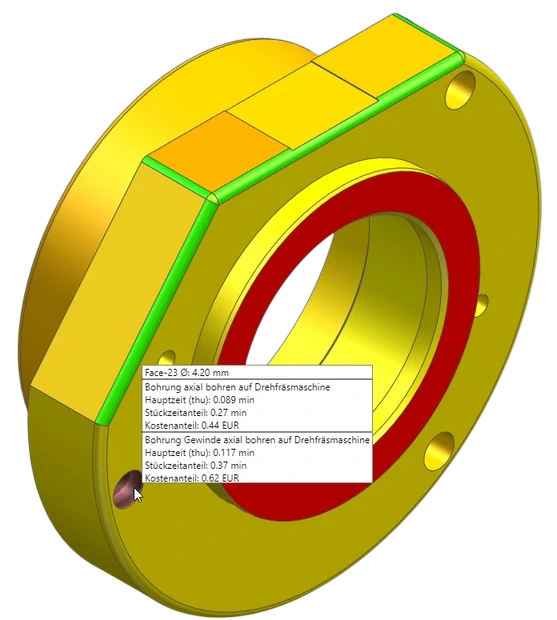
Traffic light colors provide quick orientation and an overview.
Design engineers can quickly identify where the greatest cost-saving potential lies.

How to find new ways to smartly consolidate supplier inquiries.
You are able to identify similar geometries at a glance? Not so with similar manufacturing processes, though; simus classmate identifies both and turns them into concrete opportunities for negotiation.
Objective costing provides clarity and enables fact-based decision-making.
This allows for a well-founded comparison of in-house production with supplier scenarios.


Materials, processing methods, and manufacturing techniques are taken into account.
You will receive reliable, traceable information that can be used directly to calculate the product’s carbon footprint.
Read more: How design engineers can influence the Product Carbon Footprint »
Up to 80% of a product’s manufacturing costs are determined during the development phase.
Traditional costing methods are often manual, slow, and dependent on individual experience. This leads to uncertainty in the early stages – precisely when key decisions are being made. Without reliable cost estimation, there is a risk of late and costly design changes, missed opportunities for cost savings during development, and delays in proposals and approvals.
What precise, automated costing achieves:
“For around 80 percent of our components, simus classmate calculates the manufacturing costs in advance with a hit rate of 95 percent. The designers build up their own knowledge and achieve their cost targets better without our support.”

“The fact that all material master data can be found quickly simplifies and speeds up the various maintenance and repair tasks.”
“We are very taken with the solution’s versatility and see classmate PLAN as a centerpiece for our efforts to make the manufacturing process leaner, more flexible and more cost effective.”
1. What is automated manufacturing cost calculation based on a 3D CAD model?
In automated manufacturing cost calculation, software analyzes the geometry of a 3D CAD model. Based on the identified component features, the software determines the appropriate manufacturing steps, processing times, and material and manufacturing costs. This provides transparent cost estimates as early as the design phase, without the need to manually enter all cost calculation data.
2. How does cost estimation based on a 3D model work?
The software imports the 3D CAD model and identifies geometric features such as holes, milled surfaces, or rotationally symmetric areas. It then determines a plausible manufacturing strategy and the necessary production steps. The estimated manufacturing costs are calculated based on machining times, material prices, machine hourly rates, and other calculation parameters.
3. Why should manufacturing costs be calculated as early as the design phase?
Many cost-related decisions are made as early as the product development phase. These include component geometry, materials, manufacturing processes, and required tolerances. Early cost estimation highlights the financial implications of these decisions. Design engineers can compare variants, reduce cost drivers, and avoid costly changes in later project phases.
4. What data is required for automatic production cost calculation?
The most important foundation is the 3D CAD model of the part or assembly. In addition, material data, raw material prices, machine hourly rates, manufacturing technologies, and other company-specific costing parameters can be used. Information from technical drawings—such as tolerances, threads, or surface requirements—can also be captured using AI-powered drawing analysis and assigned to the 3D model.
5. What results does the calculation based on the 3D CAD model provide?
The automated CAD cost estimation provides a preliminary estimate of material and manufacturing costs. In addition, it can determine machining times, required manufacturing processes, individual operations, and the sequence of work steps. The results can be broken down by components, operations, or individual manufacturing areas and used for automatically generated production routings.
6. How fast and reliable is automated CAD cost estimation?
Depending on the component and system configuration, the calculation can be completed in a matter of seconds. Standardized calculation rules ensure that cost estimates are consistent and traceable. The quality of the results depends in particular on the available CAD data, the stored manufacturing technologies, and the company-specific costing parameters.
7. Can assemblies and welded assemblies also be costed automatically?
Yes, in addition to individual manufactured parts, the software can also calculate costs for complex assemblies and welded assemblies. The software analyzes the components included and uses this information to determine the estimated costs. Different scenarios can be considered, such as prototype or mass production, as well as production at different manufacturing sites.
8. How are company-specific manufacturing costs taken into account?
General technological calculation parameters—such as cutting parameters for turning and milling operations—can be stored in a technology database. Companies can add custom values such as machine hourly rates, material prices, surcharges, or site-specific manufacturing conditions. This allows the cost estimate to be tailored to the company’s own machines, processes, and cost structures.
9. How can cost drivers be identified directly in the CAD model?
Cost-intensive areas of a component can be highlighted in color on the 3D model. A traffic-light system marks comparatively expensive manufacturing areas in red and less expensive areas in yellow or green. Detailed information on manufacturing processes, processing times, and costs can be displayed for individual areas. This makes potential optimization opportunities immediately visible in the design.
10. For which business units is automatic production cost calculation suitable?
Automated production cost calculation provides particular support for design, production planning, technical purchasing, cost engineering, and sales. Design engineers can develop components with cost in mind; production planning receives automatically generated work plans; and the purchasing department can evaluate supplier quotes or make-or-buy scenarios. The sales department benefits from faster and more consistent cost calculation bases for quotes.